
← All posts·AI·August 27, 2026·10 min
A cluster of Mac Studio Ultras is not a data center. For some plants, it is enough.
On 25 August 2026 Apple put M5 Ultra in the Mac Studio, with 512 GB of memory and Thunderbolt 5 clustering. We walked the spec against a Mauricie engineering office that does not want drawings on someone else’s cloud.
Jean-Christophe Proulx
Director, Digital Transformation · GOX Technologies
VP, Chief Technology Officer · Pulsatrix
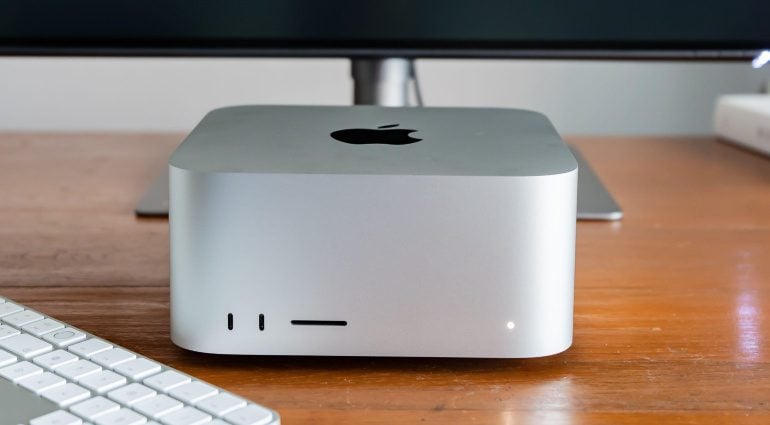
Apple announced the new Mac Studio on 25 August 2026. Pre-order that day. Boxes start shipping 22 September. The headline is the M5 Ultra: up to a 36-core CPU, an 80-core GPU with a Neural Accelerator in every GPU core, and up to 512 GB of unified memory. Johny Srouji called it their most powerful Mac ever. That is their job. Ours is to say whether four of them on a shelf replace a rack, or whether they just look expensive next to the fax.
The plant that asked us this question does not train foundation models. They have an engineering office, a pile of STEP files, and a purchasing clerk who is tired of pasting specs into a chatbot that lives in Virginia. They wanted a box in the building. The Mac Studio is the smallest box that can hold a serious local model without a 600 watt card screaming in a ThinkStation.
01What Apple actually shipped
Two chips. M5 Max starts at 2,499 US dollars: 18-core CPU, up to a 40-core GPU, up to 128 GB of unified memory, about 614 GB/s of bandwidth. M5 Ultra starts at 5,499 US dollars: twice the CPU, twice the GPU, up to 512 GB (that config lands late October), 1.2 TB/s of bandwidth. Apple says the Ultra is up to 4.3 times the peak AI compute of the last generation, and up to 4 times faster at LLM prompt processing than the M3 Ultra. Wi-Fi 7 and Bluetooth 6 showed up for the first time. Thunderbolt 5 is the port that matters.
Unified memory is the trick people skip. On a Windows workstation the model lives in GPU memory, 96 GB if you bought the RTX PRO 6000, and the rest of the PC is a spectator. On a Mac the CPU and the GPU share one pool. A 70 billion parameter model that would spill off a 48 GB card can sit in 128 GB and still have room for context. That is why people buy these for local AI. It is not magic. It is a big shared desk.
02Clustering is a cable, not a miracle
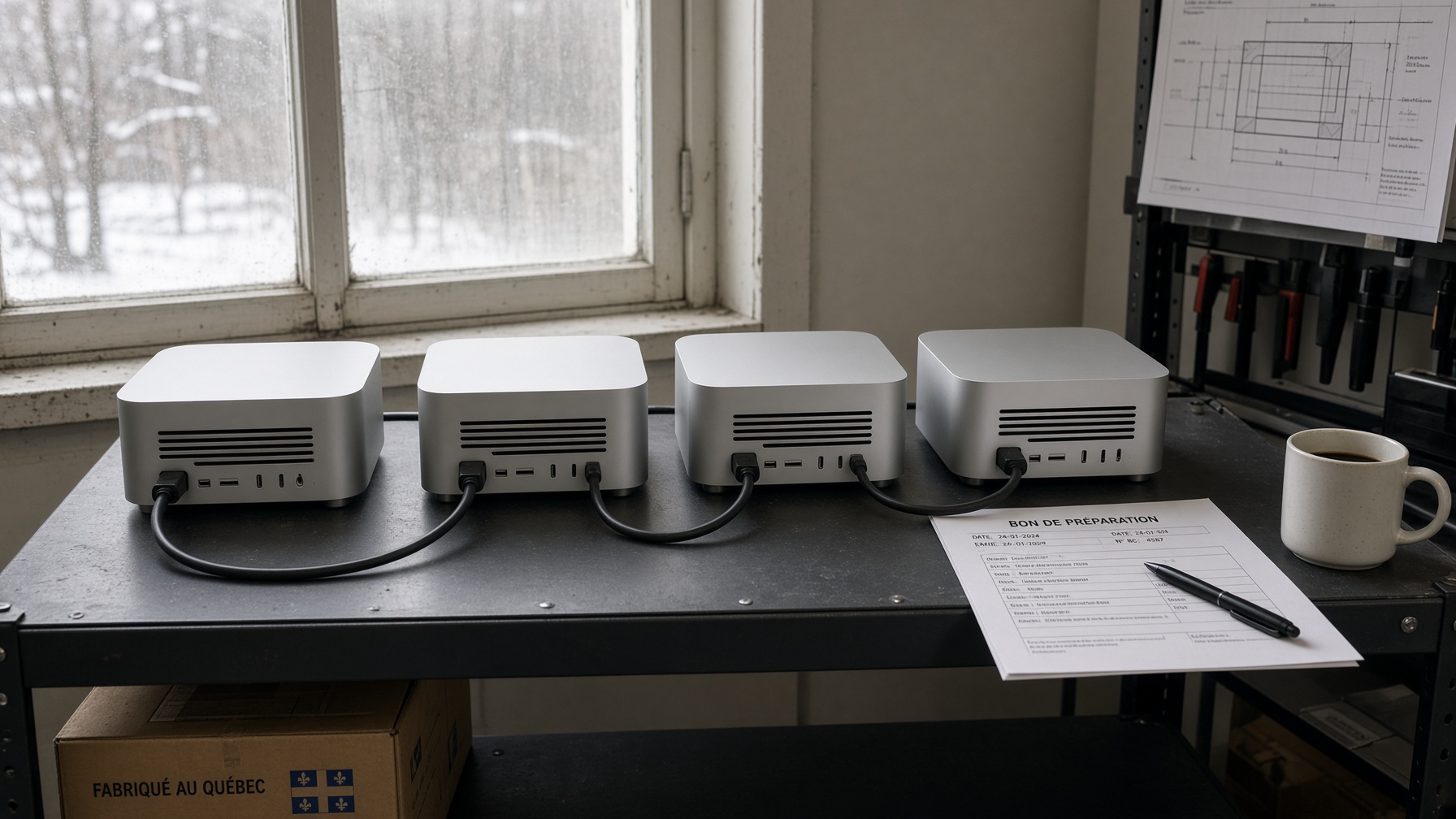
Apple is explicit. Several Mac Studios can share work over Thunderbolt 5 using RDMA, remote direct memory access, which is a fancy way of saying the machines copy tensors without bothering the CPU too much. A cluster of four, they say, is up to 3 times faster at distributed AI inference than a single Studio. Not 4 times. The cable is not free. If you try five, you run out of a full mesh of ports and you build a ring. Rings hurt. We would stop at four, on one shelf, labelled, with a UPS that is not a joke.
People have been chaining M3 Ultra Studios for a year with community tools. Some of it works. Some of it locks a GPU at 100 percent and the launcher dies. Apple putting RDMA in the brochure does not finish the software. If you buy this for a plant, you are buying a small, quiet, private inference box. You are not buying a cluster appliance with a support number in Mandarin. Someone still has to own MLX, the model files, and the night it stops answering.
03What this is good for in Mauricie
A local model that reads a drawing, a procedure, or a pile of packing slips, and never leaves the building. Engineering asking a 32B or 70B model about last year’s similar part, with the files on a volume that Fortinet already knows. A copilot for the office that does not sit in Copilot’s cloud. Overnight jobs: classify a folder of PDFs, draft a French summary, wait for a human in the morning. The power bill is the quiet part. An M3 Ultra Studio idled around 9 watts and peaked near 270. A 24/7 box is a few tens of dollars a month, not a new electrical service.
Four Ultras on a shelf can hold a frontier-class open model in memory that a single RTX 6000 cannot. That sentence is true. It is also the only sentence some resellers will tell you. The next sentence is: Visual, EDI, and the shop copilot we already run are Windows and GPU. The Mac cluster does not replace Infor. It sits beside the people who already work in Preview and Finder, and it keeps the PDF in-house.
04Where we would not put it
On the dock. In a rack that already has a FortiGate and a Lenovo SR650. As the only GPU in a plant that lives in SolidWorks or Visual. As a training box. Apple is selling inference and creative work. Fine-tuning a plant model overnight, MIG, NVIDIA AI Enterprise, CUDA, those still live on a ThinkStation or a ThinkSystem. Mixing four Macs into the domain like they were another Lenovo is how you get a beautiful cluster that nobody can patch in January.
Also: the 512 GB Ultra is the one the cluster story is written for, and it ships late October. If a vendor is quoting four of those for September, they are selling a slide. Start with one Ultra you can actually hold. Put a real job on it for a week. Then talk about cables.
05A week that would not embarrass you
Monday: one M5 Ultra, 128 GB is enough to learn. Install the model you actually need, not the biggest one on Hugging Face. Tuesday: feed it last month’s packing slips and three procedures. Measure wrong answers out loud. Wednesday: decide the human gate. The Mac drafts. A person still posts. Thursday: if the answers are boring and useful, then and only then price a second and a third Studio. Friday: if the answers are poetic, you learned something cheap. You did not buy a cluster.
We like the Mac Studio when the work is already on a Mac, or when the point of the exercise is that the file never leaves the parish. We like a Lenovo ThinkStation with an RTX PRO 6000 when the work is CAD, CUDA, or the same Windows image as the rest of the floor. We like a ThinkSystem SR675i when several teams will share the model and the box has to live in a rack with a contract. Call us before you order four silver toasters. The cable is the easy part.
If this is your week on the floor, write to us. A person reads it.
Let’s talkMore from the blog
AI
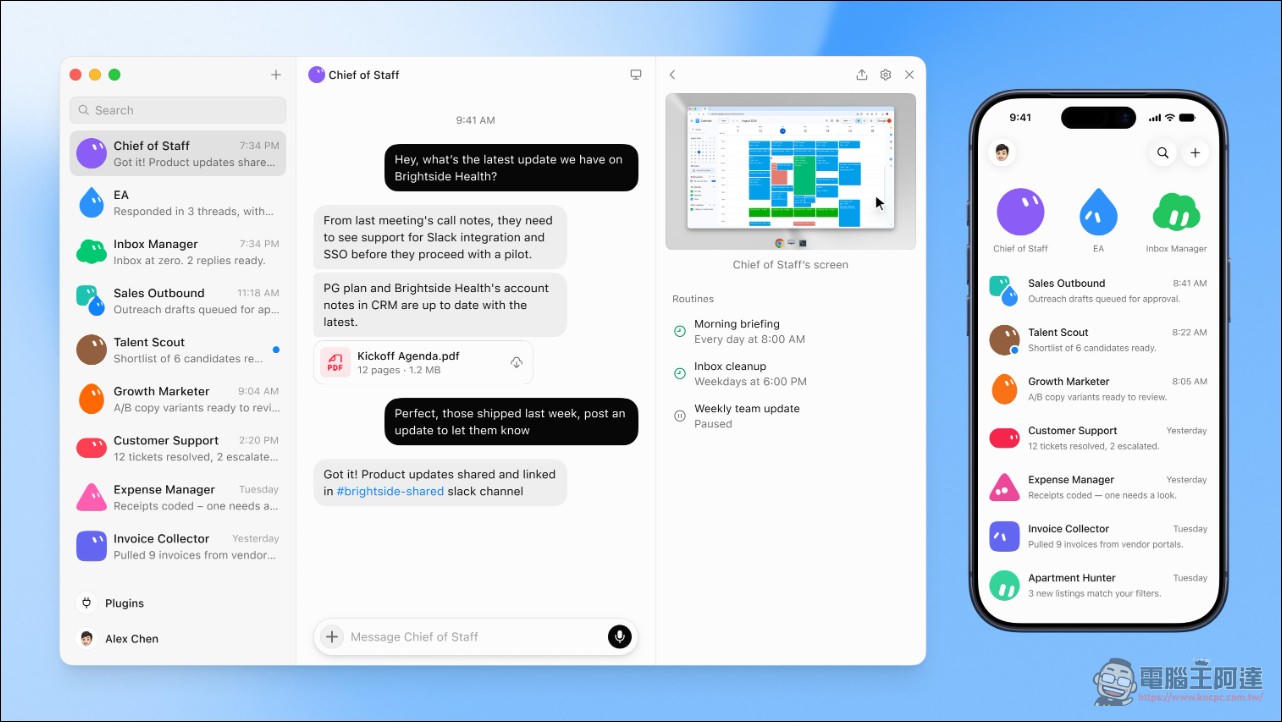
Grok Bot is an always-on teammate. Here is how a Quebec plant should actually use it.
xAI launched Grok Bot on 11 August 2026: named agents with their own cloud computer, who keep working after you close the laptop. We walked their playbook against a receiving dock, an AP inbox, and a helpdesk. The useful part is not the magic. It is the approval.
AI
Where should the data sleep?
A local model, Copilot, or Claude. The right choice is an address, not a religion. Here is how we pick with you.

AI
The agent should not write the purchase order.
Automation is wonderful until it posts the wrong line. Our rule is simple enough to write on a sticky note.